1. Executive Summary
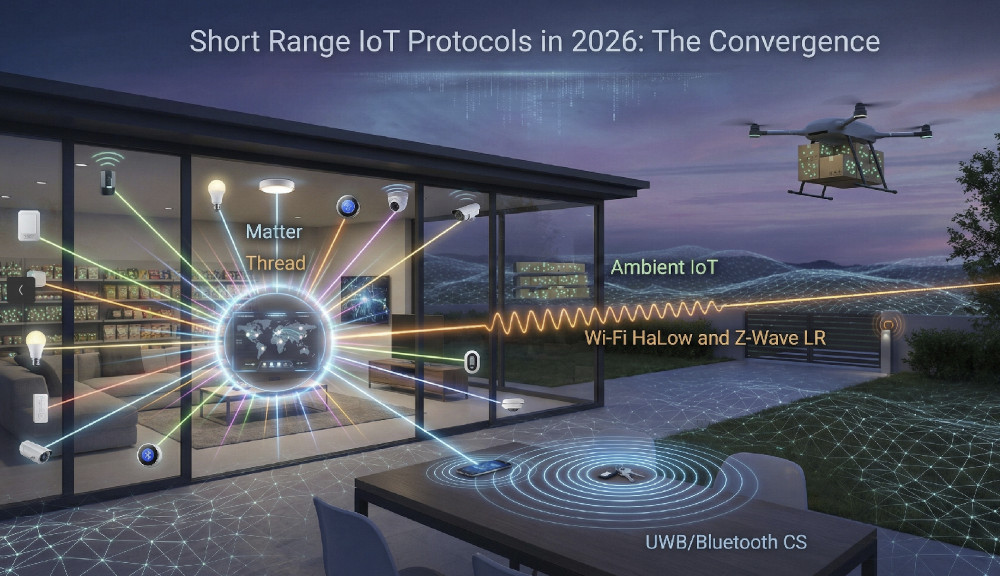
By 2026, the short-range Internet of Things (IoT) landscape has shifted from a decade of fragmentation to an era defined by unified application layers, specialized physical transports, and battery-less computing. The market has matured beyond simple connectivity, driven by the stabilization of Matter 1.5, the ubiquity of Thread 1.4, and the commercial breakthrough of sub-gigahertz technologies like Wi-Fi HaLow and Z-Wave Long Range.
Three distinct technological vectors define 2026. First, the Range Revolution has bridged the gap between Personal Area Networks (PANs) and LPWANs using sub-GHz spectrum to transmit high-bandwidth video and telemetry over kilometers. Second, the Precision Revolution has monetized proximity; Bluetooth Channel Sounding (CS) and Ultra-Wideband (UWB) now provide secure, centimeter-level spatial awareness. Third, Ambient IoT has begun digitizing trillions of unpowered assets through passive, backscatter-based communication standardized in 3GPP Release 19.
This blog post analyzes the technical, regulatory, and commercial dynamics shaping short-range IoT in 2026, from next-generation silicon to the impact of the EU Cyber Resilience Act.
2. The Unified Application Layer: Matter 1.5
The "protocol wars" have largely resolved into a unified application layer. Matter 1.5, iterating biannually, now decouples device functionality from the transport method, allowing manufacturers to focus on hardware innovation rather than proprietary APIs.
2.1 Native Camera and Energy Intelligence
Matter 1.5 represents a significant leap from early versions by supporting complex, high-bandwidth device types.
2.2 Bridging the Legacy Gap
While native Matter devices dominate, "brownfield" deployments rely on standardized Matter Bridges. Modern consumer routers and hubs (e.g., Samsung SmartThings Hub v4, Homey Pro) now integrate bridging software, seamlessly exposing legacy Z-Wave and Zigbee sensors to the Matter fabric. This preserves the superior sub-GHz characteristics of legacy sensors while unifying control.
3. The Thread 1.4 Backbone
Thread has cemented itself as the standard for low-power IP mesh networking. The release of Thread 1.4 addressed critical reliability issues that plagued earlier deployments.
3.1 Unifying the Mesh
The "multi-mesh" fragmentation—where Apple, Google, and Amazon border routers created competing islands—is resolved. Thread 1.4 mandates Standardized Credential Sharing, forcing border routers to recognize and join existing networks. This creates a singular, self-healing mesh where a failure in one hub is instantly compensated by another.
3.2 Thread over Infrastructure
Thread 1.4 significantly reduces latency by tunneling packets over the home's high-speed Wi-Fi or Ethernet backbone. Instead of hopping through multiple low-power bulbs, a message enters the mesh and is routed via the nearest border router to its destination. This reduces average latency in large networks (192+ nodes) to under 100 milliseconds.
4. The Range Revolution: Wi-Fi HaLow and Z-Wave LR
As smart environments expand to "smart properties," 2.4 GHz radios fail to penetrate exterior walls. 2026 sees the sub-GHz spectrum (800–900 MHz) dominated by Wi-Fi HaLow and Z-Wave Long Range.
4.1 Wi-Fi HaLow: Scaling IP to the Kilometer
Wi-Fi HaLow (IEEE 802.11ah) has exited the niche phase, driven by chipsets like the Morse Micro MM8108. It is the only long-range protocol capable of transmitting HD video.
-
Performance: Using OFDM modulation and 256-QAM, HaLow achieves throughputs from 150 kbps to over 40 Mbps. It delivers video streams at 600 meters and sensor data beyond 1 kilometer.
-
Matter Certification: In a pivotal 2025/2026 shift, Wi-Fi HaLow was certified as a Matter transport. This allows long-range security cameras and gate controllers to join the Matter fabric directly via IP.
4.2 Z-Wave Long Range (LR): The Coin-Cell Champion
Z-Wave LR, built on 800-series silicon (e.g., Silicon Labs ZG23), dominates the ultra-low-power sensor market. By utilizing a star topology instead of a mesh, it eliminates hop latency and extends range to 1.5 miles (2.4 km) line-of-sight.
Verdict: Integrators now deploy both: HaLow for video/bandwidth-heavy perimeter devices, and Z-Wave LR for critical, maintenance-free sensors.
5. The Precision Revolution: UWB and Bluetooth Channel Sounding
Precise location is now a requirement for secure access and automation. The market is split between the premium accuracy of Ultra-Wideband (UWB) and the ubiquitous utility of Bluetooth Channel Sounding (CS).
5.1 Bluetooth Channel Sounding: Democratizing Precision
Ratified in Bluetooth 6.0, Channel Sounding introduces Phase-Based Ranging (PBR) to standard Bluetooth radios. This upgrade offers distance accuracy of 10–20 cm, a massive improvement over RSSI.
5.2 Ultra-Wideband (UWB): The Premium Tier
UWB remains the gold standard for high-security applications (Digital Key 3.0) and radar-based sensing.
6. Ambient IoT: The Battery-Less Frontier
2026 marks the tipping point for Ambient IoT—devices that harvest energy from radio waves, light, or vibration.
6.1 Standardization: 3GPP & Bluetooth
3GPP Release 19 has standardized passive, backscatter-based communication within 5G-Advanced, enabling cellular base stations to read battery-less tags.
7. Semiconductor & Regional Trends
7.1 Edge AI and RISC-V
-
Edge AI: Chips like Silicon Labs' Series 3 and Nordic's nRF54 integrate dedicated AI accelerators. This allows devices to process vibration or voice data locally, transmitting only insights to save power.
-
RISC-V: There is a notable shift toward RISC-V architectures for low-power IoT cores, allowing custom instruction sets for cryptography and signal processing.
7.2 The Rise of NearLink (China)
While the West standardizes on Matter/Thread, China has coalesced around NearLink (SparkLink). Driven by Huawei and trade restrictions, it creates a bifurcated market where global manufacturers must support dual stacks to compete in China.
8. Regulatory Frameworks: Security by Design
The "secure by afterthought" era is over. 2026 is defined by strict enforcement.
9. Conclusion
In 2026, the short-range IoT ecosystem has achieved a sophisticated equilibrium. Matter and Thread have solved the interoperability crisis, Wi-Fi HaLow and Z-Wave LR have conquered the range limitations, and Ambient IoT is expanding connectivity to the trillions of unpowered assets. For stakeholders, success no longer lies in choosing a protocol, but in orchestrating these complementary technologies to deliver secure, precise, and intelligent experiences.