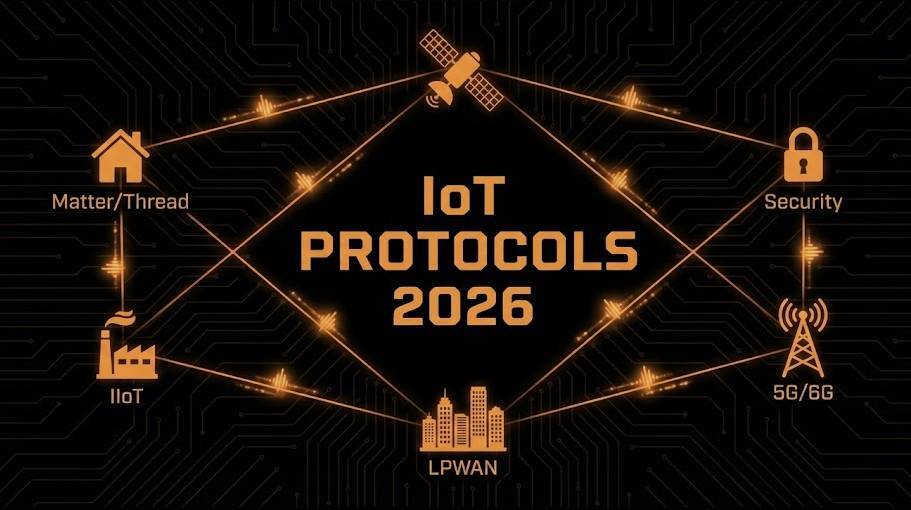
In the early 2020s, the Internet of Things (IoT) was often described as a fragmented "Wild West" of competing standards and proprietary silos. Fast forward to 2026, and that landscape has undergone a tectonic shift. We have moved past the era of simply connecting things to an era of operational intelligence.
For the modern IoT architect, the challenge is no longer just making a device talk to a server. It is about navigating a complex web of regulatory pressure, fragmented global connectivity, and the rising demand for AI-driven edge decisions. At Hacod, we recognize that the primary psychological driver for clients today is risk mitigation. Most IoT projects fail in the "Valley of Death" between a working prototype and a scalable, manufacturable product. Your choice of communication protocol is the connective tissue that determines whether you bridge that gap or fall into it.
This deep dive explores the dominant communication protocols of 2026, deconstructing how they bridge the physical-digital divide and why your choice of protocol is now a high-stakes business decision.
The Consumer Revolution: Matter and Thread
In 2026, the smart home and office are finally living up to their promise, largely thanks to the maturation of Matter. Matter has effectively ended the protocol wars for consumer electronics by providing a unified application layer that runs over Thread, Wi-Fi, and Ethernet.
The Interoperability Mandate
Matter allows devices from diverse manufacturers to coexist in a single ecosystem. It is no longer about whether an Apple device can talk to a Google hub: it is about a universal language that ensures seamless operation.
-
Thread as the Backbone: For low-power devices like sensors and smart locks, Thread (based on IEEE 802.15.4) has become the gold standard. It offers a self-healing mesh architecture that gets stronger as more devices are added.
-
Integrated Border Routers: In 2026, Thread Border Routers are no longer separate, clunky hubs. They are integrated into smart speakers, televisions, and even light switches, providing near-hardwired responsiveness across the building.
Ambient Intelligence and Short Range Connectivity
The latest iterations of these protocols have expanded to support spatial sensing and ambient intelligence. Protocols are no longer just carrying "On/Off" commands: they are transporting rich data from AI-powered sensors that can detect falls or track occupancy in real-time while maintaining local privacy. For a deeper look at how these local networks are evolving, explore our analysis of short-range IoT protocols in 2026: the convergence of connectivity, precision, and ambient intelligence.
The Precision Revolution: Ultra Wideband (UWB)
While Bluetooth and Wi-Fi excel at connectivity, 2026 has seen the rise of Ultra-Wideband (UWB) as the definitive protocol for spatial awareness. UWB is not competing to be the "data pipe" (though it can handle high rates): it is winning the battle for precision.
Centimeter Level Accuracy
UWB operates by sending billions of ultra-short pulses across a wide spectrum (3.1 to 10.6 GHz). Because these pulses are so short, receivers can measure "Time of Flight" with incredible accuracy.
-
Hands-Free Access Control: UWB enables secure entry where the door unlocks only when you are within centimeters of the handle, moving toward it. This eliminates the "relay attacks" that plague legacy Bluetooth and NFC systems.
-
Asset Tracking 2.0: In industrial settings, UWB allows managers to track tools and components within 10 centimeters inside a warehouse, reducing search time and optimizing logistics.
-
Proximity-Based UI: Smartphones in 2026 use UWB to understand which appliance you are pointing at, automatically pulling up the correct controls on your screen.
Cellular LPWAN: The Battle for the Wide Area
For industrial and enterprise deployments that require long-distance communication, the choice between NB-IoT and LTE-M has become a nuanced trade-off between mobility, throughput, and power.
The Roam-Ready Reality
By 2026, the historical barriers to cellular IoT (unpredictable roaming and opaque contracts) have been addressed by software-led networks. Multi-region network backbones now allow devices to stay authenticated and stable even when crossing borders, a critical requirement for global supply chain trackers.
-
NB-IoT (Narrowband IoT): This remains the king of deep indoor penetration and ultra-low power consumption. It is the go-to for smart meters and environmental sensors that are static and only need to send small bursts of data.
-
LTE-M (Cat-M1): For anything that moves, LTE-M is the standard. It supports full handover between cell towers and offers enough bandwidth for firmware updates over the air (FOTA) and even voice capabilities (VoLTE).
Both NB-IoT and LTE-M are now officially integrated into the 5G evolution. This ensures that hardware investments made today will be supported well into the 2030s, providing the long-term stability required for infrastructure projects.
Industrial IoT: Determinism and Interoperability
On the factory floor, the "Black Box" of proprietary industrial protocols is being replaced by the open, real-time synergy of OPC UA over TSN.
The Power of TSN (Time-Sensitive Networking)
Standard Ethernet was never designed for real-time control: it is "best-effort" by nature. TSN, a set of IEEE 802.1 standards, changes this by adding determinism to the network.
-
Sub-microsecond Precision: TSN allows for the kind of synchronization vital for high-speed robotics and motion control.
-
Network Convergence: It enables critical control traffic and standard IT traffic, such as video streams or web browsing, to share the same physical cable without interference.
OPC UA: The Semantic Layer
While TSN handles the highway, OPC UA provides the language. It offers a standardized way to structure data, making it both human-readable and machine-interpretable. In 2026, this combination allows for sensor-to-cloud transparency. AI algorithms can now ingest factory data for predictive maintenance without the need for costly custom middleware.
Smart Cities and Utilities: LoRaWAN vs. Wi-SUN
For massive, city-scale deployments, non-cellular Low Power Wide Area Networks (LPWAN) still hold a significant share of the market due to their cost-effectiveness and range.
-
LoRaWAN: This protocol remains the leader for deep indoor penetration and long-range connectivity. It is the primary choice for smart parking, waste management, and environmental monitoring where data payloads are tiny and infrequent.
-
Wi-SUN (Wireless Smart Ubiquitous Network): Built on IEEE 802.15.4g, Wi-SUN has gained massive traction for smart grids. Its mesh topology and relatively high data rates (up to 300 kbps) make it ideal for utility companies that need to manage millions of end-points with high reliability and no vendor lock-in.
Technical Protocol Comparison
Choosing the right protocol requires a side-by-side look at the technical trade-offs. The following table summarizes the landscape for 2026:
| Protocol |
Topology |
Range |
Max Data Rate |
Power Efficiency |
Precision |
| Matter (Thread) |
Mesh |
Short (Indoor) |
250 kbps |
Ultra-High |
Low |
| BLE 5.4+ |
Star/Mesh |
Short |
2 Mbps |
Ultra-High |
Medium (CS) |
| UWB |
Peer-to-Peer |
Short |
Up to 27 Mbps |
Medium |
Centimeter |
| Wi-Fi 7 |
Star |
Medium |
30 Gbps+ |
Low |
Low |
| NB-IoT |
Star |
Long (10km+) |
120 kbps |
High |
Low |
| LTE-M |
Star |
Long (5km+) |
1 Mbps |
Medium |
Low |
| LoRaWAN |
Star |
Very Long (15km+) |
50 kbps |
High |
Low |
| Wi-SUN |
Mesh |
Long (Variable) |
300 kbps |
Medium |
Low |
The Security Paradigm: From Afterthought to Architecture
In 2026, security is no longer a feature. It is a regulatory mandate. With the full implementation of the EU NIS2 Directive and the U.S. Cyber Trust Mark, non-compliant devices are effectively undeployable.
Rust: The New Standard for Secure Firmware
To mitigate the memory-unsafe vulnerabilities of legacy C and C++, leading IoT firms like Hacod have migrated to Rust for protocol stack development.
-
Memory Safety: Rust eliminates up to 70 percent of common security vulnerabilities, such as buffer overflows, at the compiler level.
-
Zero-Trust for IoT: Every connection in 2026 must pass a posture check. Protocols are now integrated with Hardware Security Modules (HSMs) to ensure that every device has a unique, cryptographic identity.
Regulatory Pressure and Patchability
Regulations now require "Secure-by-Design" principles, including mandatory patchability. Any device that cannot be updated securely over the air is now considered a stranded asset. At Hacod, we champion the use of Rust and secure FOTA (Firmware Over-The-Air) updates to ensure your fleet remains rock-solid against evolving threats.
Engineering for the Valley of Death
The IoT market of 2026 rewards those who manage risk with the speed of the digital world. Successful projects are no longer defined by how many devices are connected, but by whether those devices can operate under regulatory pressure and fragmented networks.
When choosing your communication stack, remember these core principles:
-
Prioritize Interoperability: Use open standards like Matter or OPC UA to avoid vendor lock-in and reduce long-term integration debt.
-
Design for Manufacturing (DFM): Ensure your protocol choice aligns with available chipsets and global supply chain realities.
-
Lead with Security: Memory safety is non-negotiable. Building your protocol stacks in Rust is no longer an "innovation": it is a requirement for mission-critical reliability.
At Hacod, we don't just write code: we ship products. We combine rigorous hardware design, secure embedded firmware, and scalable cloud infrastructure to bring your product to market on time and manufacturing-ready. From silicon to cloud, we build the connected reality of 2026.