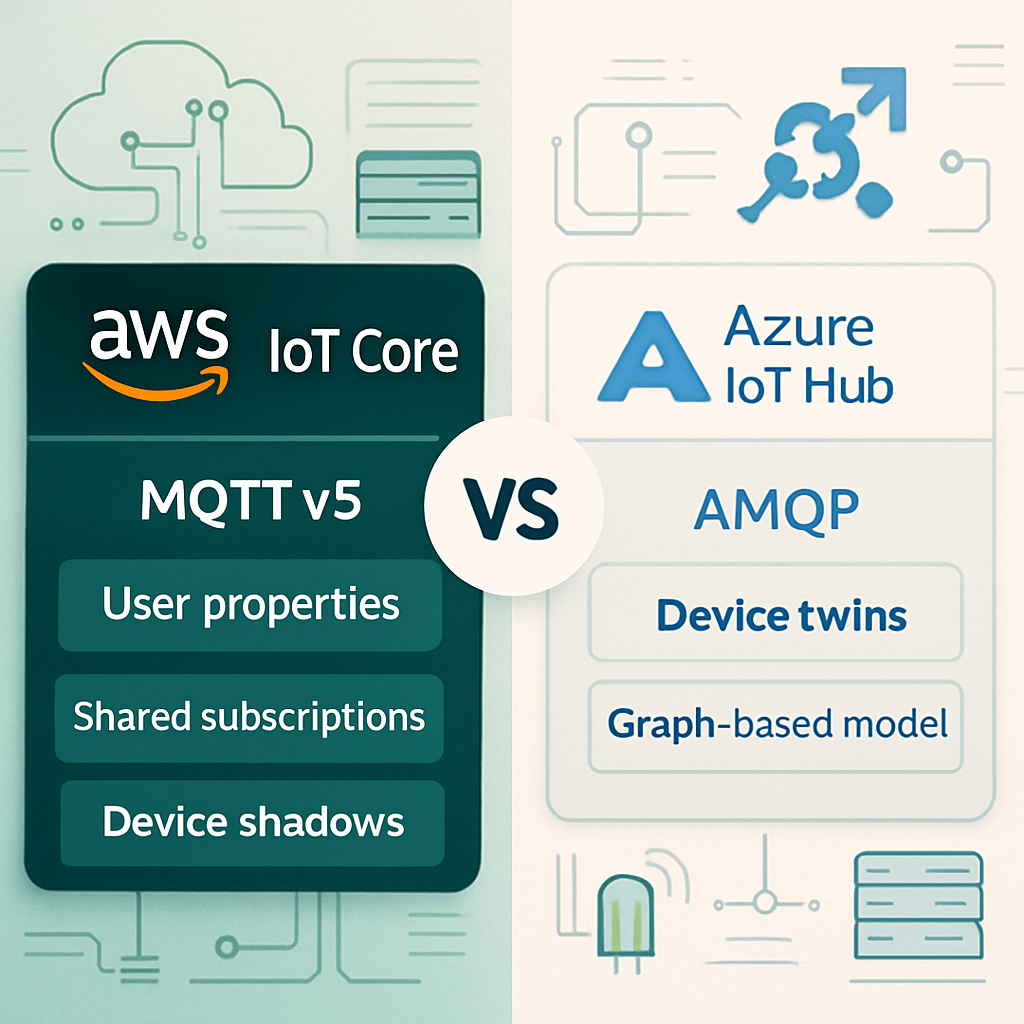
In the lifecycle of any connected product, there is a distinct point of no return: the selection of the cloud ingress broker. For the CTO, this is rarely a question of “which platform works?” - both Amazon Web Services (AWS) and Microsoft Azure have proven they can ingest telemetry at hyperscale. When comparing aws and azure, it is essential to evaluate their cloud platforms for IoT solutions based on scalability, security, analytics, and overall suitability for different IoT needs. IoT cloud platforms like AWS IoT Core and Azure IoT Hub serve as the essential infrastructure for IoT projects, offering robust capabilities and integration options for scalable and efficient deployments.
Choosing between AWS IoT Core and Azure IoT Hub is not a feature checklist exercise; it is a decision between two fundamentally different philosophies regarding concurrency, billing, and state management. In the rapidly expanding iot market, AWS and Azure are dominant players, shaping the direction and growth of IoT solutions worldwide. This article presents an iot vs analysis, directly comparing AWS IoT and Azure IoT to help you determine the best fit for your project. Both providers offer a wide range of iot offerings and iot products, including dedicated cloud services, integration capabilities, management dashboards, and analytics features designed for diverse IoT needs. As an engineering team, we have deployed fleets ranging from 10,000 to 1 million endpoints on both platforms. This analysis strips away the marketing abstractions to evaluate the mechanical and financial realities of scaling on these two hyperscalers.
Introduction to IoT Platforms
IoT platforms are the backbone of any modern IoT solution, providing the essential infrastructure for connecting, managing, and analyzing data from a diverse array of IoT devices. These platforms deliver a suite of cloud services designed to streamline device management, enable secure data ingestion, and support the rapid development of IoT applications. When evaluating an IoT platform, enterprise architects must consider not only the ability to connect and manage thousands—or millions—of connected devices, but also how well the platform integrates with existing systems and scales to meet future demands.
AWS IoT Core stands out as a managed cloud service that enables seamless, secure communication between IoT devices and the AWS cloud. It supports a wide range of protocols and offers robust device management capabilities, making it a strong foundation for scalable IoT solutions. On the other hand, Azure IoT Hub serves as a central message hub for bi-directional communication between IoT applications and devices, providing reliable device connectivity and integration with the broader Azure ecosystem. Both platforms offer comprehensive tools for device management, data ingestion, and the deployment of IoT applications, allowing organizations to build, scale, and manage their IoT initiatives with confidence. Ultimately, the choice of IoT platform will shape the architecture, security, and scalability of your connected products for years to come.
The Protocol Layer: MQTT v5 and the "Chatty" Device
For years, the industry standardized on MQTT v3.1.1. It was lightweight and sufficient. However, as edge logic becomes more complex, the limitations of v3.1.1 -specifically regarding error reporting and flow control-have become technical debt triggers.
AWS IoT Core: The Modern Standard
AWS IoT Core has aggressively adopted MQTT v5, and for a greenfield architecture in 2025, this is a significant differentiator. MQTT v5 introduces features that solve specific distributed system headaches without requiring custom application-layer logic:
-
Request/Response Pattern: Historically, implementing a synchronous command over MQTT required correlating publish/subscribe topics manually. MQTT v5 handles this natively with response topics, simplifying the firmware logic for command-and-control operations.
-
User Properties: This allows you to add key-value pairs to the message header. You can route messages based on metadata (e.g., firmware_version=2.1) without parsing the payload, significantly reducing compute costs in the cloud processing layer.
-
Shared Subscriptions: This is perhaps the most critical feature for scalability. It allows multiple backend services to subscribe to a single topic and have the broker load-balance the messages between them. On AWS, this allows for backend consumer scaling without complex sharding logic.
Azure IoT Hub: The Legacy Constraint
Azure IoT Hub supports MQTT, but its architecture has historically leaned heavily on AMQP for advanced features.1 While Azure supports MQTT v3.1.1 and v5 via its newer "IoT Operations" connectors, the native Hub experience often forces architects into AMQP if they need robust file upload or complex feedback loops. For a fleet of resource-constrained microcontrollers (e.g., Cortex-M4 running Zephyr), implementing a heavy AMQP stack is often non-viable compared to a lightweight MQTT client.
Architectural Takeaway: If your fleet relies on modern, lightweight, standard-compliant communication (especially if you are using Rust/Embassy on the edge), AWS IoT Core's native MQTT v5 support offers a cleaner implementation path with less firmware overhead.
State Management: Device Shadows vs. Device Twins
Both platforms offer a mechanism to synchronize state between the device and the cloud - AWS calls them Device Shadows, and Azure calls them Device Twins. While they serve the same function (storing reported and desired states), their implementation dictates your application architecture.
AWS Device Shadows
AWS treats the Shadow as a document store. A device can have multiple "Named Shadows," which is a powerful feature for separation of concerns.
-
Use Case: You can have one shadow for "Firmware Status" (managed by the DevOps team) and a separate shadow for "User Configuration" (managed by the mobile app team). This prevents race conditions where an update to the user's LED color preference accidentally overwrites the firmware update status.
-
Cost Implication: AWS charges for Shadow operations (reads/writes). If your application polls the shadow aggressively, costs scale linearly with user activity.
Azure Device Twins & The Digital Twin Narrative
Azure's Device Twin is part of a broader, graph-based narrative. While it supports tags and properties like AWS, it integrates tightly with Azure Digital Twins (ADT)
-
The Graph Model: Azure pushes you toward modeling the relationship between devices (e.g., "Sensor A" is contained in "Room B" which is part of "Building C"). This is defined using the Digital Twins Definition Language (DTDL).
-
Use Case: This is superior for complex, spatial environments like smart buildings or factories where the context of the data is as important as the data itself.
Architectural Takeaway: If your device is an atomic unit (e.g., a consumer smartwatch), AWS Named Shadows provide a simpler, modular development experience. If your device is a node in a complex hierarchy (e.g., an HVAC controller in a smart campus), Azure's graph-based approach reduces the need for a separate relational database to map assets.
The Financial Architecture: Metered vs. Tiered Scalability
This is where the “Enterprise Architect” must work closely with the CFO. The billing models of the two platforms are diametrically opposed, creating different risk profiles. Additionally, AWS IoT Events is a key AWS IoT service with its own separate pricing model, which should be considered when evaluating overall cost implications.
AWS IoT Core: The Serverless/Metered Model
AWS utilizes a pay-as-you-go model. You are billed separately for connectivity (minutes connected), messaging (number of messages), and shadow operations.
-
Pros: Zero idle cost. If you have 100,000 devices that only report once a day, your bill is negligible. It scales perfectly with actual usage.
-
Cons: Bill Shock. A firmware bug that causes a device to enter a retry loop (e.g., publishing an error log every 100ms) can generate astronomical bills in hours. You strictly need AWS Budgets and throttling rules (Device Defender) to mitigate this.
Azure IoT Hub: The Provisioned Capacity Model
Azure requires you to choose a "Tier" (Basic or Standard) and a "Unit" size (1, 2, 3). Each unit buys you a daily quota of messages.
-
Pros: Predictability. You know exactly what your bill will be at the end of the month. It acts like CapEx-you buy the capacity, and you own it.
-
Cons: The "Step Function" Cost. If you need 401,000 messages per day, and a Unit provides 400,000, you must buy a second Unit, effectively doubling your cost for a 0.25% increase in traffic. You pay for reserved capacity regardless of whether you use it.
Architectural Takeaway:
-
Choose AWS for fleets with highly variable traffic or low-duty-cycle devices (e.g., asset trackers reporting twice daily).
-
Choose Azure for fleets with predictable, high-frequency telemetry (e.g., industrial vibration sensors reporting at 1Hz continuous), where you can saturate the provisioned capacity to achieve a lower per-message cost.
4. Downstream Integration: SiteWise vs. Data Explorer
Ingesting data is only the first step. The “Scalability” of a platform is defined by how easily it moves data to a hot storage or analytics layer. Analytics and machine learning are critical components in downstream integration, enabling IoT platforms to deliver advanced insights and automation. Data storage solutions provided by cloud platforms are essential for managing and analyzing IoT data efficiently and securely.
4.1 AWS IoT Core Downstream Integration
AWS IoT Core integrates with AWS IoT SiteWise for industrial data collection and monitoring. AWS IoT Analytics is also used to analyze data from IoT devices, helping organizations gain insights and improve operations.
4.2 Azure IoT Hub Downstream Integration
Azure IoT Hub integrates with Azure Data Explorer and Microsoft Fabric for advanced analytics and visualization. Integration with Azure services, such as Azure Machine Learning, Azure Functions, and Azure Digital Twins, further enhances analytics and management capabilities. Azure Stream Analytics plays a key role in real-time data processing and analytics, enabling organizations to ingest and analyze IoT data as it arrives.
Both AWS and Azure provide robust tools to manage IoT applications efficiently at scale.
AWS IoT SiteWise
For industrial clients, AWS offers IoT SiteWise. It is a managed service specifically designed to model industrial assets and ingest time-series data.
-
Integration: It sits directly behind the IoT Core Rule engine.
-
Strength: It solves the "Historian" problem. It automatically computes metrics (aggregates, averages) and provides a highly performant API for retrieving historical trends. It is the engine behind "Predictive Maintenance" dashboards.
Azure Integration (Synapse & Fabric)
Azure excels in integration with the Microsoft enterprise stack. The path from IoT Hub to Azure Data Explorer (ADX) or Microsoft Fabric is seamless.
-
Strength: For organizations already deeply invested in the Microsoft ecosystem (PowerBI, Dynamics 365), Azure IoT Hub acts as a native data pump. The ability to query raw telemetry using Kusto Query Language (KQL) in ADX is a superpower for debugging fleet issues that AWS CloudWatch Logs struggles to match in terms of query speed.
IoT Edge Computing and Scalability
As IoT deployments grow in complexity and scale, edge computing has become a critical strategy for achieving real-time data processing and efficient system performance. By moving compute resources closer to where data is generated—on the edge devices themselves—organizations can reduce latency, minimize bandwidth usage, and enable faster decision-making. Both AWS IoT and Azure IoT have invested heavily in edge computing capabilities, offering robust solutions for deploying and managing workloads at the edge.
AWS IoT Greengrass empowers organizations to run AWS Lambda functions, data processing, and machine learning inference directly on edge devices, enabling local analysis and action even when connectivity to the cloud is intermittent. This approach not only enhances performance but also supports scalable, distributed IoT solutions. Similarly, Azure IoT Edge allows for the deployment of containerized workloads, including Azure Machine Learning models, to edge devices, providing flexibility and powerful edge computing capabilities. Both platforms support autoscaling, load balancing, and integration with their respective cloud services to ensure that IoT solutions can handle surges in data and device traffic.
For organizations seeking managed services to further simplify scaling, AWS IoT Sitewise and Azure IoT Central offer end-to-end solutions for device management, data ingestion, and analytics. These services make it easier to manage large fleets of edge devices, process streaming data, and analyze IoT data at scale. By leveraging these edge computing and management tools, enterprises can deploy IoT solutions that are not only scalable but also resilient and responsive to real-world demands.
Security & Device Management
Security is the primary gatekeeper for scaling. Managing 100 certificates is easy; managing 1 million requires automation. Both AWS IoT Core and Azure IoT Hub are secure cloud based platforms that support scalable and secure IoT deployments. Security is especially critical in industrial IoT environments, where large-scale device management and compliance are essential.
-
Azure Device Provisioning Service (DPS): Azure’s DPS is widely considered the gold standard for secure, zero-touch provisioning. It supports complex enrollment policies and TPM attestation out of the box. It allows for “Late Binding”-manufacturing devices without knowing which specific IoT Hub they will belong to until they are turned on.
-
Azure Active Directory: Azure Active Directory plays a key role in authenticating devices and enabling secure communication, enhancing threat monitoring and integration across Azure IoT solutions.
-
AWS IoT Device Defender: AWS focuses heavily on behavioral security. AWS IoT Device Defender provides device authentication, continuous monitoring, and ML-based anomaly detection to ensure IoT device security and compliance in production environments. It can monitor metrics (e.g., “Why is this thermostat sending 50MB of data outbound?”) and trigger audits or disconnects, serving as an intrusion detection system (IDS) specifically for your IoT fleet.
-
Azure Sphere: Azure Sphere is a comprehensive end-to-end IoT security solution that offers hardware-level protection, a dedicated operating system, and cloud-based threat detection, safeguarding IoT devices from the silicon to the cloud.
Selecting the Right IoT Platform
Choosing the right IoT platform is a strategic decision that hinges on the unique requirements of your IoT project, your existing technology stack, and the expertise within your organization. Both AWS IoT and Azure IoT offer extensive portfolios of IoT services, but their strengths and focus areas differ. AWS IoT provides a comprehensive suite of services, including AWS IoT Analytics for advanced data analytics and AWS IoT Device Management for large-scale device operations, making it a versatile choice for organizations seeking flexibility and breadth. In contrast, Azure IoT is deeply integrated with Microsoft’s ecosystem, with offerings like Azure IoT Central for rapid application development and Azure IoT Edge for seamless edge deployments, making it particularly attractive for enterprises already invested in Microsoft Azure.
When evaluating IoT platforms, it’s essential to consider factors such as device management capabilities, data analytics tools, security features, and the scalability of the platform. The level of support, documentation, and community engagement provided by the platform vendor can also play a significant role in the success of your IoT initiatives. Additionally, alternative platforms like Google Cloud IoT and Microsoft Azure IoT Edge offer unique features that may align with specific project needs, especially for organizations with multi-cloud strategies or specialized requirements.
Ultimately, the right IoT platform will be the one that aligns with your business objectives, technical requirements, and long-term vision for IoT deployments. By carefully assessing the strengths of each platform—whether it’s the advanced analytics of AWS IoT, the seamless integration of Azure IoT, or the specialized capabilities of Google Cloud IoT—organizations can confidently select a solution that supports their IoT projects and drives innovation at scale.
Conclusion: Avoiding the Platform Mismatch
There is no "winner" in a vacuum, but there is certainly a "wrong choice" for your specific business model.
Select AWS IoT Core if:
-
Your pattern is Event-Driven: You need granular, sub-second scaling for consumer devices.
-
You need MQTT v5: Your firmware architecture relies on modern protocol features like shared subscriptions.
-
Your traffic is "Bursty": You don't want to pay for idle capacity during the night.
Select Azure IoT Hub if:
-
Your pattern is High-Throughput/Industrial: You have predictable data streams that make tiered pricing more economical.
-
You value the "Digital Twin" Graph: Your problem domain is spatial or hierarchical (Smart Buildings/Factories).
-
You require Enterprise Integration: Your business stakeholders live in PowerBI and Microsoft Fabric.
At Hacod, we advise our clients to look past the initial "Hello World" connection. The cost of migrating 100,000 devices from one cloud to another involves truck rolls, firmware refactoring, and data migration nightmares. The scalable choice is the one that aligns with your unit economics and your data strategy - not just today, but at 10x your current scale.